
The Resilience Gone Wild Methodology
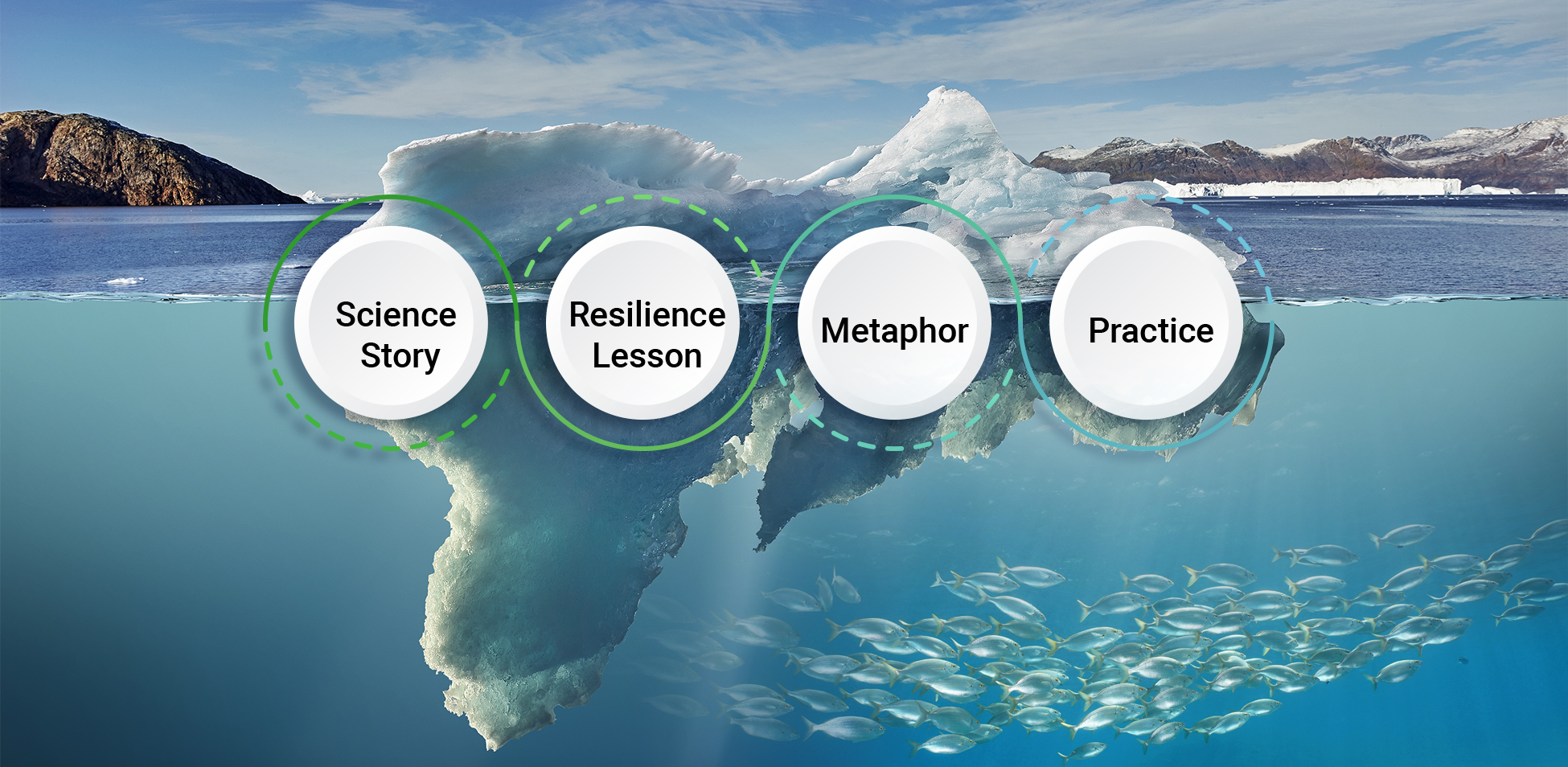
Imagine you are standing on the deck of a research vessel in the Arctic Ocean. The water is glassy and still. Then, without warning, a massive iceberg explodes into motion — rolling over completely in what looks like slow motion but is actually a sudden, violent revolution. For weeks or months it had been melting unevenly, quietly shifting its center of gravity until the tipping point arrived. When it flipped, the complex ecosystem thriving in the cold darkness below was suddenly revealed to the world. Just like that iceberg, most of what shapes us remains hidden beneath the surface — our unseen strengths, our unprocessed experiences, our unexpressed gifts. What might change if you brought more of that to the light?
That is the heart of how Resilience Gone Wild works — and it always begins in the same place: with science.
A real behavior. A real adaptation. A real survival strategy that a real species has been perfecting across deep time. Then the powerful question: what do they know? This science and spark of imagination lead to the resilience lesson, the lesson leads to the metaphor, and the metaphor becomes a resilience tool with practices you can start putting to use right away.
Our brains are wired for story. And a metaphor communicates an entire story. When we encounter a compelling metaphor, like the parrotfish in her sleep bubble, the brain responds as if the metaphor were real — activating sensory, emotional, and motor regions simultaneously. This is why stories stick when facts alone slide right past us. Metaphors drawn from nature are especially powerful because they engage the brain's integrative regions — the ones responsible for empathy, creativity, long-term thinking, and emotional regulation. They promote calm and curiosity. They mirror the complex, interconnected systems we actually live within. And because they are grounded in something real — a behavior tested across millions of years — they carry a kind of authority and staying power that is uniquely their own.
A resilience tool only works if you use it. You only use it if you remember it. And you remember it best when it arrived wrapped in a story you couldn't stop thinking about.
From story to practice — four steps
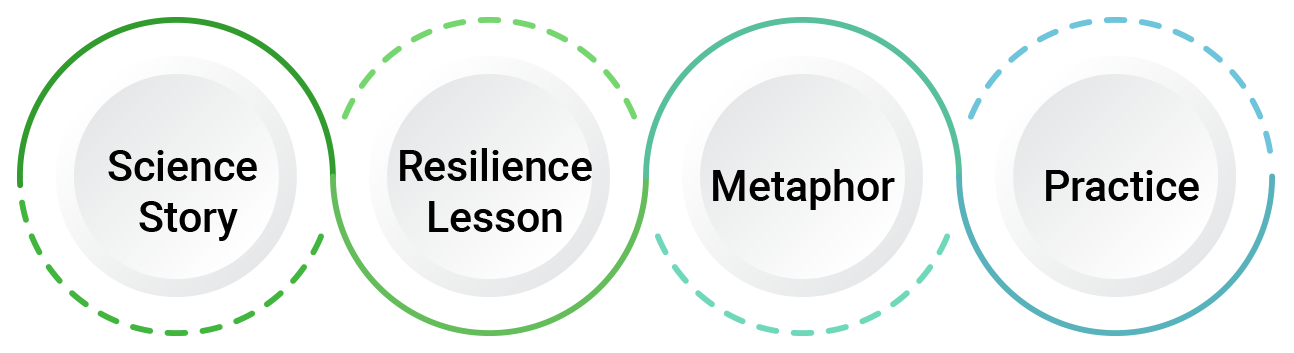
Every Resilience Gone Wild tool moves through the same arc: science story, lesson, metaphor, practice.
Here's what that looks like with two of the Resilience Gone Wild founding teachers of this work.
The parrotfish spends up to an hour every night intentionally constructing that protective mucus cocoon before she sleeps. She has made a choice — if she senses the need to protect herself from danger, she makes the decision to invest her time, energy, and resources into the effort. That mucus cocoon masks her scent from predators, shields her skin from parasites, cushions her from the currents, and if a threat pops her bubble, a built-in alarm wakes her just in time to swim away. Millions of years of perfecting a nightly ritual.
What does she know? That sleep is how she wakes up ready to pursue her purpose another day — and that the conditions for good rest have to be built intentionally. The practice for us? Identify your own predators — the sensory irritants in your sleep environment keeping your nervous system on alert, like light or sound. Identify your parasites — the mental noise that follows you to bed, like worries or unfinished to-do lists. Address them one at a time. Each one you tackle strengthens your cocoon and improves your sleep. And next time you or someone you care about is struggling for a good night's sleep? Bring the metaphor of the parrotfish sleep bubble to mind and practice the resilience tool that has been modeled for us.
The leatherback sea turtle is the largest species of sea turtle on Earth — and the only one with a soft, flexible, accordion-like shell rather than a hard one. That softness allows her to compress her shell under the crushing pressure of ocean dives that can reach over 13,000 feet deep, then expand it again as she rises. She moves with the pressure rather than against it.
What does she know? That flexibility is a survival strategy — and that the capacity to adapt under pressure is what allows her to go deeper than any other turtle on Earth. The practice: consider where in your life you are holding tightly to a "should" — a fixed expectation or a way things are supposed to go. What might open up if you softened that grip, the way the leatherback softens into the deep against pressure and changing environments? And next time you feel the pressure to soften your rigid ways and beliefs, remember the leatherback and how she becomes flexible under pressure.
Parrotfish and sea turtles were my first Resilience Gone Wild teachers. I have shared these stories widely and created many more to help us all flourish — because when we know more about nature, fall in love and awe of it, and recognize our deep interconnection and responsibility for it, we all win.
A living library
This is where my mind goes when I connect with nature — to the wow, and to exploring the science of the brilliant resilience they live every day, and how we can all win and flourish from it. There are many Resilience Gone Wild stories for you to explore, and many more coming, in my podcasts, writing, teachings, and talks — polar bears, tardigrades, banyan trees, laughing gulls, honey badgers, coffee plants, giant tortoises, and so many more. Each one offers a true story, a lesson, a metaphor, and a practice. Each one translates millions of years of hard-won adaptive wisdom into something you can carry into your day.
There is another dimension to this work that is extremely important too. We are all already walking around with nature metaphors embedded in our language — and many carry distortions, deep negativity, fear, and ugliness rather than resilience, beauty, and truth. Calling someone a rat or a snake or a shark. Saying an idea is a weed. These feel like simple shorthand, and that is exactly the issue: they quietly shape perception without us noticing. Part of what Resilience Gone Wild does is replace those distortions with the real story — because when you know what a species actually does, the metaphor transforms entirely, and so does what it teaches.
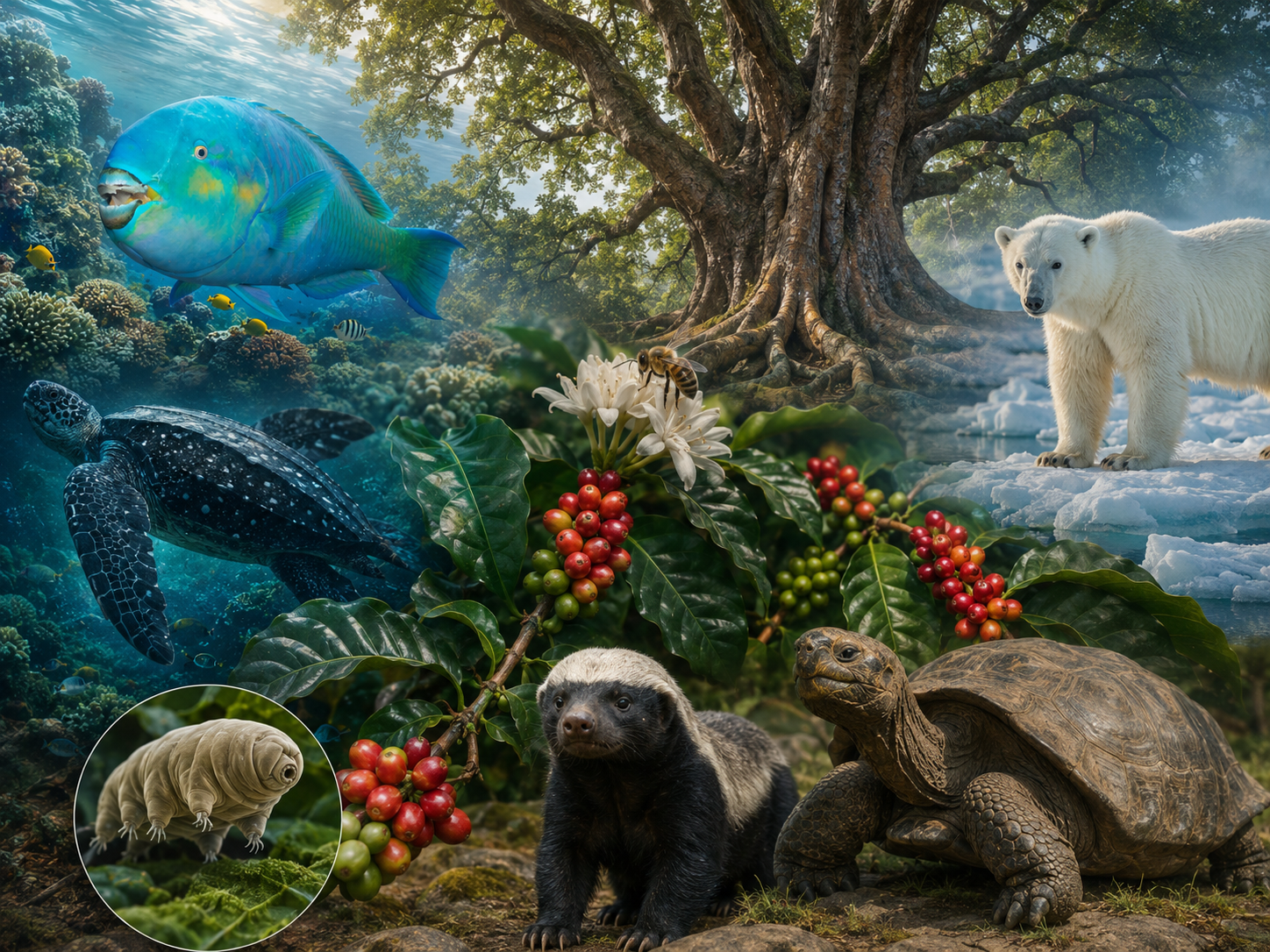
The library keeps growing. Nature keeps teaching. And there is always another species waiting to change the way you see everything.
The WinWinWin Mindset
We live in a moment saturated with win-lose thinking. The rhetoric of competition, dominance, and zero-sum outcomes has become so loud and so constant that it can start to feel like the only way the world works. You win, I lose. I win, you lose. Someone always has to come out on top.
I refuse to accept that. And nature shows us exactly why we don't have to.
The WinWinWin Mindset grew from several converging streams of my life and work. Through my IPEC coaching studies, I came to understand that the highest level of positive, anabolic energy a person can operate from is one where there are no losers — where decisions and actions are made from a place of genuine care for everyone affected. That insight became a cornerstone of how I think and work.
My studies in systemic team coaching deepened it further, bringing in the organizational dimension — the idea that teams, companies, and communities thrive when they think beyond their own immediate gain. And then there is the work of John Elkington, who first articulated the concept of the triple bottom line — people, planet, and profit — as a framework for measuring true organizational success. Building on that foundation, Paul Polman and Andrew Winston developed the Net Positive framework, published in their 2021 book Net Positive, which argues that the most resilient and impactful organizations are the ones that leave the world measurably better than they found it. Not just avoiding harm. Actually generating good.
The WinWinWin Mindset brings all of this together into a simple but powerful lens for every decision, every creation, every interaction: you, those you care about, and the wild world we all share can all win — and the world can be a little better off for it. That last part matters deeply to me. It's not enough to divide the pie fairly. The goal is to grow the pie, nourish the soil it grew in, and leave seeds for the next one.
Nature already knows this. The giant tortoise of the Galápagos is one of my favorite living models. When we protect and restore tortoise populations from near extinction, the tortoises win. And as they move slowly through the overgrown landscape, they forge new pathways that other animals can use to travel and find food. They turn the soil as they walk, dropping seeds along the path — seeds that take root, grow into new food sources, and nourish the entire ecosystem around them. Everyone wins. The land wins. The future wins. That is net positive. That is WinWinWin made visible.
This mindset is not a program or a module I add to my work. It is woven into everything I create — every resilience tool, every workshop, every story, every practice. Because a world where we each strengthen ourselves, care for those around us, and actively contribute to the health of the living systems we depend on is not idealism. It is the most practical and proven survival strategy on Earth. Nature got there billions of years ahead of us.
Ready to Go Deeper?
Whatever brought you here — your own resilience journey, a search for fresh inspiration, or exploring what Resilience Gone Wild could bring to your organization — there's a natural next step waiting for you.