Follow Your Current: Rivers, Resilience, and When to Swim Upstream
May 25, 2026
Cutting Through the Jargon
Sustainability, resilience, regeneration: three parts of one living system, and a shared language for talking about them.
If you work anywhere in the area of sustainability, you know how slippery the language can be. Sustainability, resilience, regeneration, ESG, circularity, CSR, triple bottom line, net positive... The terms cross over and mingle until even those of us who live in this world can lose track of how they actually fit together. And if we can't always hold it clearly ourselves, no wonder it's hard to explain to a colleague, a CFO, or the team we're trying to bring along.
I want to make three of those words easier. Sustainability, resilience, and regeneration are three that too often get tangled together or set in competition. I developed a way to explain them clearly for a workshop I'm presenting at SB26 in San Diego on June 8, with my long-time friend Helen Sahi, Group Sustainability Officer at BIC. It's based on my Resilience Gone Wild methodology: when something is hard to explain, I turn to nature for the wisdom that simplifies it. I'm sharing it here because it might help you too, so you and your peers, and the people you manage up and down, can have a more helpful conversation about why our work matters, the challenges and the solutions, and how to bring more of the inputs, outputs, and impacts into the ROI calculation.
A main challenge in that conversation is that the trio often gets treated as a pathway, a sequence. First you do sustainability, then you move on to resilience, then you reach for regeneration, each one framed as if it outgrows the one before.
They aren't a pathway though. They're a system. All three are needed. All the time. Each one strengthening the others.
To show that, I offer you mangroves because they have been doing the work sustainability professionals are charged with building into organizations for 80 million years.
A mangrove has three interconnected layers, all part of one living system, all working all the time.
Roots: Sustainability
The roots are the foundation everything else depends on. They anchor the tree in shifting mud where almost nothing else can hold. They breathe oxygen into ground that would more likely suffocate them. They filter harsh salt and pollutants before they can poison the tree. They break the daily wave energy of every tide. And they shelter the next generation of fish, crabs, and shrimp in a protected nursery while it grows.
This is the daily, foundational work and investment that holds steady through everyday life. In an organization, it's the integrated practices that keep the whole operation standing: responsible sourcing, emissions and waste reduction, supplier standards, the materiality work that screens out risk before it reaches the business. Most of it happens out of sight. Everything else rests and relies on it.
Branches: Resilience
The branches and aboveground roots during lower tides are what make a mangrove a mangrove. They lift the tree out of the water in a tangled mesh of strength. They bend with hurricane-force winds rather than break. They distribute the load across the whole network, so no single point carries the full stress. And the forest is always dropping new shoots that root and thicken the structure. Every storm interweaves the branches further, adding to their strength.
These are the investments that absorb disruption beyond the everyday, the extraordinary rather than the ordinary. When a supplier region floods, when a regulation lands without warning, when a material gets banned, the diversified sourcing and pre-built relationships you invested in are what let the business bend instead of break. The mangrove converts disruption into more resilient structure. So can an organization.

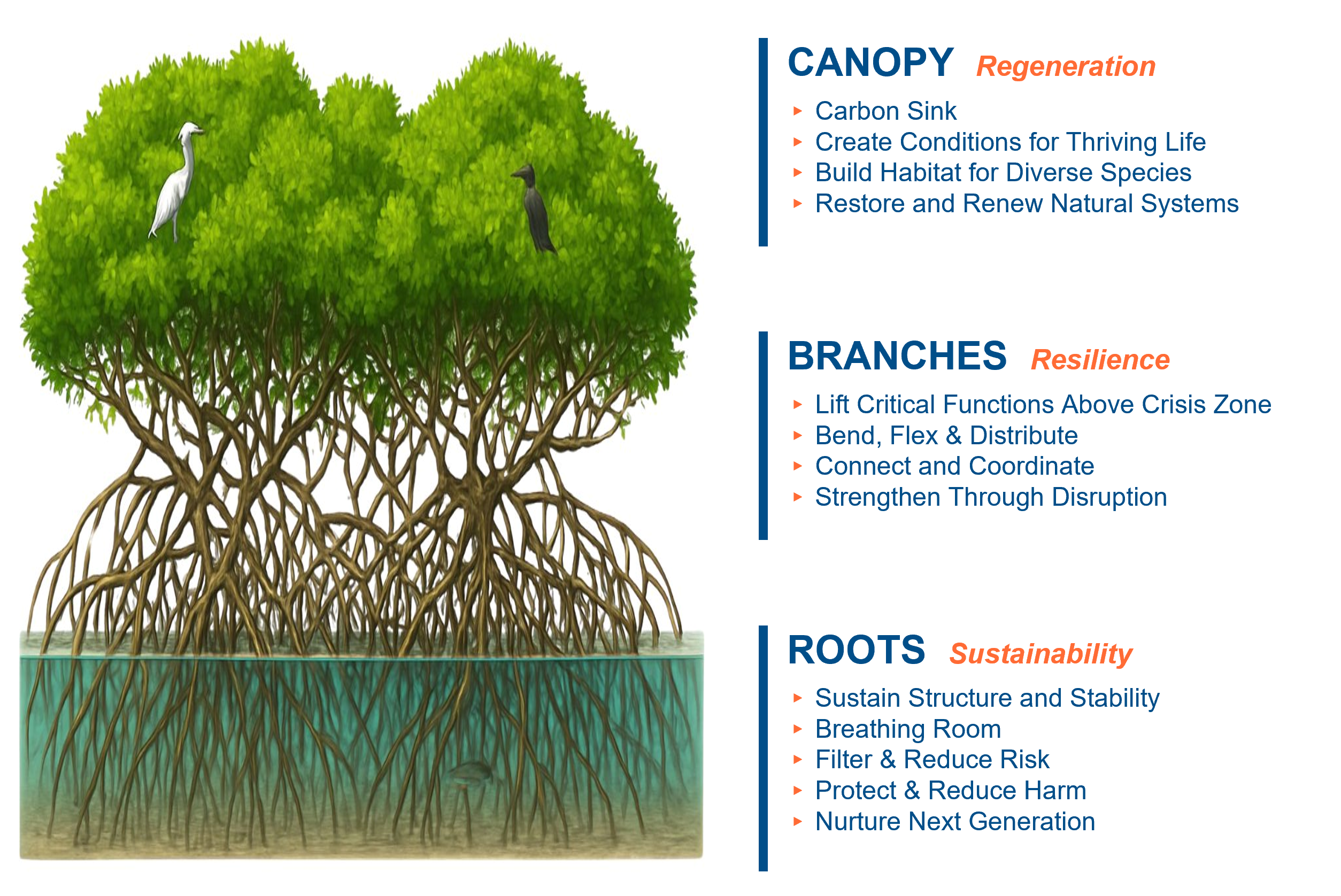
Canopy: Regeneration
The canopy is where the mangrove gives back to everything around it. It pulls carbon from the air at rates few ecosystems can match. It creates the conditions where life flourishes below. It builds shade and habitat for hundreds of species. Leaves drop into the water and feed the whole food web.
This is active contribution beyond the company's own boundaries. Net positive contributions like reforestation and watershed restoration, and regenerative agriculture that rebuilds soil for the next generation of farmers. Helping ecosystems of diverse suppliers and communities thrive for the long term. Work that gives back more than it takes.
The part most people miss
Here is what really makes the mangrove and our work a living system.
The roots feed the branches. The branches lift the canopy. The canopy protects and drops leaves that feed the roots. Each part makes the others flourish.
Pull one out, and the whole system fails, eventually.
Take away the roots, and there is nothing to hold the structure when the water moves. The foundation washes out. The tree that looked strong on a calm day topples in the first real storm. An organization that stops doing the quiet, daily, foundational work still looks fine for a while, until the ground shifts and there is nothing underneath.
Take away the branches, and the tree cannot bend. The next hurricane that the flexible structure would have absorbed now snaps it. An organization with a solid foundation and a generous outward reach, yet no capacity to flex when the extraordinary hits, breaks at exactly the moment it most needs to hold.
Take away the canopy, and the system stops feeding itself. No leaves fall, no carbon is captured, nothing is returned to the water that the roots depend on. The forest survives, for a time, taking and never giving back, slowly starving the very system that sustains it. An organization can run this way too, defending and maintaining, contributing nothing outward, until the world it depends on quietly stops supporting it.
Now picture the opposite. When all three are working at once, the mangrove does what no single part could do alone. A hurricane that flattens the coastline leaves the mangrove forest standing. The roots held the ground, the branches bent and absorbed the surge, the canopy broke the wind, and behind that forest the shoreline, the village, and the nursery of young fish came through intact. Not one of those outcomes happens without all three layers doing their work together.
Organizations work the same way. The company that had done the quiet root work, built the flexible structure, and kept contributing outward is the one still standing after the shock, still trusted by its community, still supplied by the partners who came through it too. The foundation made the resilience possible. The resilience protected the contribution. The contribution renewed the foundation. That is what winning looks like, and it only happens when all three are alive at once.
That is the case worth carrying into your next hard conversation. Not "we should do all three because it's good practice." Rather: here is what breaks when one is missing, and here is what it costs. That's the argument that moves this work from a line item to be trimmed into the foundation everything else depends on.
It is hard to cut what someone can finally see holding the whole thing up.
The picture does the work
A shared image drawn from nature is memorable. You'll picture a tangled vibrant mangrove long after the definitions have faded. Those three abstract words have become the language that enables conversations about why it all matters.
That is the whole idea. Map the system onto your own organization, find the words for the conversation you've been struggling to have, and help the people around you see the work the way you do, as vital and required to support the organization long-term. I've attached a worksheet that we used in the workshop to help you put this model into action. Love to hear how it's working for you.