


Coffee’s Powerful Nudge: Caffeine, Crisis, and the Regenerative Solution
April 28, 2026
What if your morning coffee could teach you about the power of the nudge?
April 28, 2026
Follow that Civet!
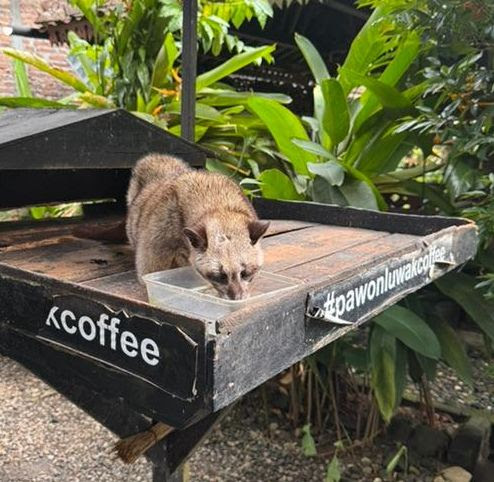
I had a coffee lover's thrill recently while visiting the island of Java. I got to taste Luwak coffee and meet an Asian palm civet, up close and personal. You may have never heard of Kopi Luwak, also known as Civet Coffee. I hadn't. It's the most expensive coffee in the world and for good reason.
This special coffee bean has an intriguing history, fitting well into the wild history of arabica beans that I share in my podcast episode.
Our Kopi Luwak story begins in the early 18th century in the Dutch East Indies, now Indonesia, specifically on the islands of Java and Sumatra. The Dutch colonial government established coffee plantations and introduced Arabica coffee from Yemen. Native workers were prohibited from picking, harvesting, or consuming coffee for themselves. There's always ways around the rules though! The locals noticed that Asian palm civets — small, nocturnal, cat-like mammals — would enter the plantations in the evening, eat only the ripest, most perfect coffee cherries, and leave the beans behind in their droppings. The workers collected the excreted beans, cleaned, roasted, and ground them to make their own brew. Turns out, civet coffee is incredibly smooth and less bitter than traditional coffee, likely because the civet's digestive enzymes break down the proteins in the beans and fermenting them which reduces the bitterness. The Dutch eventually discovered the workers' exceptional brew and transformed it from a humble substitute into a luxury item, even calling it royal.
I got to taste Kopi Luwak myself at Pawon Luwak Coffee, a coffee shop in a small village near the ancient temple Borobudur in Central Java. The coffee was smooth and rich.
Meeting the civet in the photo I took above left me thinking about what this clever creature has to teach us about resilience. The civet is a natural quality control system, selecting only the ripest, most vibrant cherries at the peak of sweetness. Then he digests what nourishes him and releases the rest. No holding on. No drama.
Choosing quality over quantity served him well. For us, the lesson is to choose only the ripest and best possible — in your work, your relationships, your commitments. The civet doesn't waste energy on what isn't worth it. Release what doesn't serve you. Keep the nourishment and let the rest go.
Alas, there is a heartbreaking footnote, a tale we hear too often. Modern demand and greed have left their handprint on the defenseless civets. Because finding and collecting wild beans is labor intensive, many producers have turned to farming the civets, keeping them in small, dirty cages and force-feeding them coffee cherries. Investigations have revealed that these captive civets suffer from stress, malnutrition, and poor health, frequently leading to self-mutilation and premature death. Experts note that coffee from caged, stressed civets is lower in quality compared to genuine, wild-sourced product. And, due to high prices of up to $600 or more per pound, the market is flooded with counterfeit Kopi Luwak, where regular coffee is falsely labeled as wild-sourced. The civet's gift, when it is free to exercise it fully, is extraordinary. Caged and compromised, that same gift diminishes.
The extra lesson? Look beyond the simple story of how humans benefit. It is usually more complex and nuanced than it first appears. The civet asks nothing of us. He simply wants to do what he does brilliantly, freely, and with extraordinary discernment. The most sustainable version of this story, every story, finds a way for every player to thrive. The civet, the coffee, the farmer, the drinker. A true win for all.

Reach Out!
Love hearing from you! Keep those emails coming! Love your comments, powerful stories of how nature's resilience has inspired you and others, ideas for upcoming podcasts and newsletters,... whatever is on your mind.
Let's start a conversation!
And, let's chat about how we can work together to get you, your team and/or your organization to WinWinWin and into a WinWinWin mindset!
Email me at Jessica@WinWinWinMindset.com
Check out my website WinWinWinMindset.com