

A Thanksgiving of Appreciation: Resilience Takes Root When We Honor One Another
November 24, 2025
Go With the FLOE: How Polar Bears Stay Steady When Life Keeps Shifting Beneath Them
December 17, 2025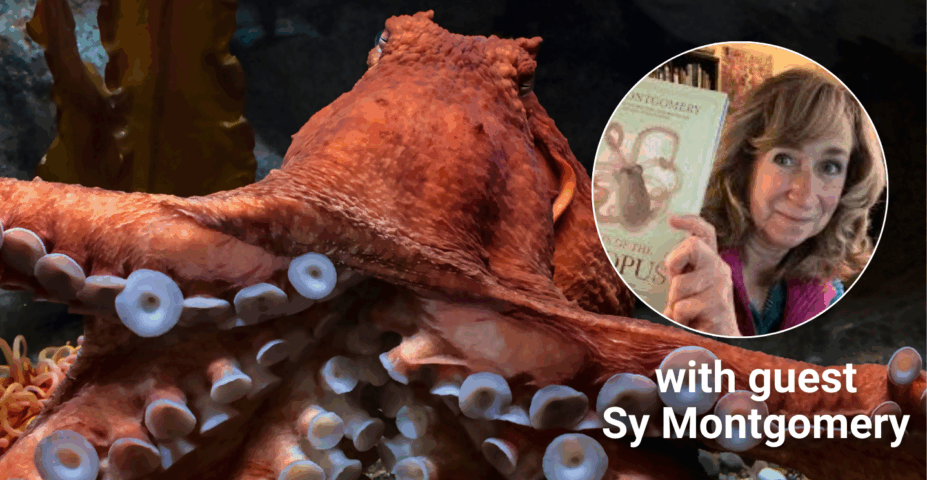
Podcast: Play in new window | Download
Episode 65
Awakening Our Soulful Intelligence: What the Octopus — and Sy Montgomery — Know
Guest: Sy Montgomery, author of The Soul of an Octopus
What if resilience doesn’t come from thinking harder or pushing faster, but from listening more deeply to the intelligence that already lives within us?
In this episode of Resilience Gone Wild, host Jessica Morgenthal explores the quiet, embodied wisdom of the giant Pacific octopus—and how soulful intelligence can help us navigate our own lives with more clarity, connection, and compassion. Joined by Sy Montgomery, bestselling author of The Soul of an Octopus, we step into a world where intelligence is fluid, intuitive, relational, and alive in every moment.
Episode Overview
In “Soulful Intelligence,” Jessica takes us into the cool stillness of a Northern Pacific kelp forest to meet the giant Pacific octopus—an animal whose distributed, sensory-rich intelligence reveals a different way of knowing the world. Through vivid storytelling, we witness how octopuses perceive, choose, communicate, and relate with a depth that challenges human assumptions about consciousness.
This exploration becomes the foundation for a rich conversation with Sy Montgomery, who expands our understanding of soul, presence, and cross-species connection. Through Sy’s stories—of octopuses, dolphins, turtles, caterpillars, dogs, and the living Earth itself—we learn how soulful intelligence deepens resilience, awakens awe, and invites us into a more relational way of being.
The result is an episode that reconnects us to our own inner wisdom, to the creatures who share our planet, and to the subtle intelligence that thrives everywhere life is paying attention.
What You’ll Learn
- How the giant Pacific octopus models soulful intelligence through presence, perception, and attunement
- Why soulful intelligence integrates mind, body, intuition, values, and relationships
- How slowing down expands our ability to sense meaning and choose wisely
- What Sy Montgomery has learned about consciousness and soul from octopuses, turtles, pink dolphins, chimps, and caterpillars
- Why love and curiosity are powerful tools of inquiry in science and in life
- How awe, reverence, and “beginner’s mind” build resilience and restore connection
- How small acts of mending—of relationships, ecosystems, and daily choices—strengthen both the world and our own internal steadiness
Episode Highlights
[00:00] Intro
[02:00] Distributed intelligence: sensing, learning, and decision-making across the body
[04:00] Camouflage as expression: color, texture, emotion, and attunement
[06:50] A quiet greeting: two octopuses meet with curiosity
[08:50] Defining soulful intelligence
[11:15] Why soulful intelligence strengthens resilience
Conversation with Sy Montgomery
[12:21] Welcoming Sy: the writer who opened the world to octopus consciousness
[14:00] Sy’s octopus teachers: Athena, Octavia, Kali, and Karma
[16:10] Soul as connection to the rest of creation
[18:25] Why naming animals changed the science of behavior
[22:39] Jane Goodall, Dian Fossey, Biruté Galdikas, and the revolution of relational science
[27:07] Scar tissue, resilience, and the sacredness of mending
[33:01] The living Earth, Gaia, and the soul of the planet
[35:06] Awe, reverence, and the responsibility of connection
[37:36] Mending as antidote to helplessness
[49:20] How humans silence their own intuition—and how to restore it
[53:49] Being massaged by pink dolphins: a story of cross-species soul
[56:42] The feedback loop of doing good
[59:16] Caterpillars, memory, and the persistence of soul
[01:02:10] Closing reflections: the intelligence that waits beneath our first thoughts
Meet the Guest
Sy Montgomery is a naturalist, bestselling author, and one of the world’s most beloved interpreters of animal consciousness. Her book The Soul of an Octopus was on the New York Times Bestseller List, was a National Book Award finalist, and reshaped public understanding of invertebrate sentience. Sy has written 39 books about animals—from hawks to pink dolphins to turtles—illuminating the relationships that remind us we are part of a living, soulful, interconnected world. Her work invites readers to listen more deeply, love more broadly, and honor the wisdom that exists beyond human boundaries.
Tools, Frameworks, or Strategies Mentioned
- Soulful Intelligence: alignment of values, intuition, sensation, and meaning
- Distributed Intelligence in Octopuses
- Beginner’s Mind in cross-species connection
- Awe as a tool for resilience
- Mending as a daily practice of healing
- The Sphere of Influence: acting where energy can truly make a difference
- Gaian consciousness and interconnected living systems
Closing Insight & CTA
“Soulful intelligence grows in the space between stimulus and response—the pause long enough for our deeper knowing to rise.”
If this episode opened something in you, share it with someone who may be searching for more meaning, more connection, or a more soulful way of navigating their life. Follow, rate, and review Resilience Gone Wild to help these stories ripple outward.
Resource Links
Sy Montgomery – https://symontgomery.com/
The Soul of an Octopus – Available wherever books are sold
Resilience Gone Wild – https://resiliencegonewild.com/
Listen to more episodes – https://pod.link/J4yd77
Produced by: Balancing Life’s Issues (BLI Studios) – https://balancinglifesissues.com/podcast-bli/
the whisper of light through kelp, the subtle information carried by the water itself. Her world is built from details we often rush past, and her wisdom rises from a kind of quiet listening that begins long before action. And that’s where today’s story begins. In a place where intelligence doesn’t rush, it simply breathes. Where awareness flows through every part of the body. Where a creature teaches us something humans often forget.
that there is a deeper way to know the world and a deeper way to know ourselves. I’m Jessica Morgenthau, and this is Resilience Gone Wild, where we explore how nature’s quiet brilliance can help us care more deeply for ourselves, for each other, and for the wild world we all share. Today, we’re stepping gently into the world of the giant Pacific octopus to explore soulful intelligence.
Transcript:
Speaker 1 (00:03.758)
Inside the cool stillness of a rocky den in the Northern Pacific, something extraordinary is happening. Quietly, slowly, almost invisibly. A being waits here, not in fear, not in hiding. She is intentional, attuned, present. If you pause long enough, you can almost sense what she senses. The faint shift of a current.
a form of inner wisdom that can strengthen our resilience in ways that reconnect us to what matters most.
Speaker 1 (01:35.662)
The afternoon light softens as it filters down through the kelp forest, turning the water into a slow-moving tapestry of greens and golds. This is her place, a quiet stretch of the Northern Pacific where cold, oxygen-rich water, drifting kelp shadows, and deep rock crevices create the perfect refuge for a giant Pacific octopus.
Speaker 1 (02:02.306)
Beneath the basalt ledge, she rests, eight arms loosely folded, mantle rising and falling as water moves across her gills. Her siphon makes a faint pulse with each exhale. Two dark, forward-facing eyes, shaped much like our own, watch the flicker of shifting light. From a distance, she seems still. Up close, she is quietly awake. Her world is built from subtle information.
Tiny shifts in current, faint chemical traces, the pressure wave of something moving nearby. Nearly 2,000 suckers line her arms, each able to taste and feel at the same time. Her arms, each containing clusters of neurons, make small decisions right where sensation happens, while her central brain integrates everything into something more. Judgment, learning, interpretation.
Scientists understand much of how she senses her world, and they’re increasingly recognizing something else in her behavior too, a thoughtful awareness that goes beyond simple reflex. There is a soulful intelligence in the way she pauses, senses, and responds, as if each moment carries meanings that rise from more than her senses alone. She slips an arm out of her den, then a second, then a third. Each moves with unhurried purpose, curling over a rock,
through crevices, along sand. Giant Pacific octopuses grow astonishingly fast, from hatchlings the size of grains of rice to powerful adults in just a few years. And the only way to manage a life like that is to learn constantly. Where food hides, what patterns matter, how currents carry clues. A crab scrapes faintly across stone. She tastes its chemical signature in the water before she ever sees it. Her eyes narrow slightly.
adjusting to the murky green light. Two arms flow outward with practice coordination. A smooth capture. Her beak, hidden beneath the soft web of her arms, makes quick, precise work of the shell. When she’s done, she uses her siphon to blow the empty fragments out of her den in a neat scatter, a kind of housekeeping that keeps her space clear. Above her, the kelp forest sways. Small fish thread through the fronds. Sunlight flickers in the patterns she has learned to read.
Speaker 1 (04:27.49)
Her skin shifts to match the moment, the mottled brown of stone, the softened pattern of kelp shadow. Chromatophores contract and expand beneath her skin, altering color in milliseconds, while tiny muscles raise or smooth her texture to mirror the rocks around her. Camouflage is not only concealment, it’s a way of showing her state, calm, alert, curious, content. There are nearly 300 species of octopus.
Caribbean reef octopuses, common octopuses, tiny pygmy species, drifting Dumbo octopuses, and the giant Pacific octopus, the largest of all, stands apart. Octopuses have been on Earth for over 300 million years, the Pacific octopus just 2 million. They live in colder waters, have broader bodies, longer arms, exceptional strength, and an especially striking blend of problem-solving, flexibility,
and individuality. Divers describe them as calm or bold, shy or playful, patient or impulsive. Personality is not a stretch, it’s an observation. A flicker enters her peripheral vision. A young octopus drifts between the kelp blades, smaller bodied, thinner armed, still learning the control of its colors. The juvenile male carries the beginnings of what will one day become the species specialized arm, the hecticotilus, used during mating.
She registers him without alarm. Giant Pacific octopuses are solitary, yet solitude does not mean disconnection. Territories can overlap at the edges, and when encounters happen, they can be surprisingly nuanced. The two octopuses pause, holding a few arm lengths of water between them. Her colors soften into a calm, steady pattern. The juvenile’s flickering settles into a gentle speckle. They assess. They wait.
they choose their next move. Octopuses communicate through posture, texture, color changes, and faint shifts in pressure. And embodied language scientists are still decoding. In this moment, both animals are reading cues. Size, intent, comfort, possibility. She extends one arm, slow, deliberate. Her leading suckers taste the water before they reach anything solid. A light touch to one of the juvenile’s arms.
Speaker 1 (06:53.782)
not a grab, a greeting. The younger octopus responds with a small curl of his own arm, a brief mutual acknowledgement, before gliding back into the kilp. Simple, yes, still meaningful, a quiet moment of connection between two conscious beings navigating the same forest. Her life includes choices like this every day, some quick, some contemplative, some, like meeting, brief and careful.
And the most profound comes at the end of her life, laying tens of thousands of eggs, tending them without leaving her den, gently blowing water across them for months, cleaning and protecting them until they hatch. She does not eat during this time. Her body slowly fades. She dies soon after they emerge. It is one of nature’s most striking acts of devotion. Presence, patience, and purpose expressed through a being whose intelligence lives throughout her body.
Back in the kelp forest, a seal passes overhead. She darkens instantly, warning red, and then slowly eases back into calm as the water settles. She evaluates, she waits, she resets when she’s ready. This is her world, alive with signals, choices, interactions, memory, and awareness. Her intelligence is not contained in a single brain or expressed through words. It is distributed, embodied, relational.
a form of consciousness scientists are still working to understand. And woven through her movements is the deep quality at the heart of our episode today. A kind of soulful intelligence, a flexible, attentive inner awareness that shapes how she moves through her place, meets other beings, and makes sense of each moment with curiosity, intention, and quiet depth.
Speaker 1 (08:50.872)
Soulful intelligence has a quiet power. It’s the form of inner wisdom that rises when we pause long enough to listen beneath our first thoughts and our first feelings. It comes from a deeper place, our values, our compassion, our intuition, our relationships, our sense of meaning and purpose. And in many ways, the giant Pacific octopus gives us a glimpse of what this kind of intelligence feels like in motion. Our giant Pacific octopus friend moves through her world
with this kind of presence. She tastes the currents before choosing a direction. She shifts her colors, patterns, textures, and shape in ways that reflect her inner state. Calm, anxious, alert, and sometimes slips into the background by mimicking the world around her. She approaches a young octopus with steady curiosity rather than fear. Each decision rises from a whole body understanding of the moment. Thoughtful, attuned, and deeply integrated.
Soulful intelligence is this deeper integration. It happens when awareness, intuition, compassion, and meaning come together. It’s not just IQ or EQ, not just what we think or feel. It’s the kind of knowing that moves from the inside out, even before we have words for it. It sounds like this choice matters. This connection deserves care. I want to act from who I truly am. This is a moment to slow down and listen.
Soulful intelligence is the alignment of head, heart, gut, values, and relationships. It steadies the system, it softens reactivity, it strengthens discernment, and it guides us toward decisions that feel grounded and true. The giant Pacific octopus shows this so clearly. She reminds us that intelligence does not have to be fast, loud, or analytical. It can be spacious, relational, and steady. It can emerge from quiet pauses, from sensing widely.
from allowing internal wisdom to rise in its own time. Her way of living teaches us that resilience is not only about recovering, it’s about responding with integrity. It’s about moving forward in ways that honor our values and our connections. It’s about letting our deeper knowing, not fear, not urgency, not habit, shape our choices. And so her lesson becomes simple and profound. Trust your soulful intelligence. Let it steady you.
Speaker 1 (11:15.298)
Let it guide you towards choices that honor your values, your relationships, and your deeper sense of meaning. And recognize that your quietest wisdom often speaks the most clearly when you give it space. And that brings us to our conversation. Because when we talk about soulful intelligence, about awareness, intuition, connection, and the deeper ways a being can know the world, there is no one better to explore this with than Sy Montgomery. Sy has spent her life listening to the inner worlds of animals.
She’s written about them with a tenderness and clarity that helps us see consciousness, emotion, and relationships where we once saw only instinct. And in the soul of an octopus, she opened a door for so many of us, revealing the depth, the mystery, and the undeniable presence inside these extraordinary beings. To help us step even further into this story, into this way of understanding intelligence and connection, I am absolutely thrilled to welcome back my friend, Sy Montgomery.
Speaker 1 (12:21.07)
So I am so, so excited to welcome you back, Cy. So welcome, Cy Montgomery, back to Resilience Gone Wild. This is such a highlight for me to get to have this conversation with you about things that just so light me up and you so light me up. We’re in season two of doing this, and I hope that we do this for like decades to come. We are gonna talk octopus and we’re gonna talk soul.
And soulful intelligence is, as far as I’m concerned, like kind of a newish concept that I’m so excited to expand and make part of people’s lives. And you are the, obviously the perfect person to bring this forth with me. I’m just so thrilled. So welcome, Sai, welcome, welcome back in your jacket and you’re up in.
in New Hampshire and like how beautiful it is to have you here. So yeah, it’s for those who don’t know you, you want to give a just a little background on why I’m so excited to have you here.
Yeah, well, I’m the author of now 39 books. They’re all nonfiction, they’re all about animals, and they’re all about our relationships with the other creatures on this earth.
And I’m just going to put it out there that you are the really important starting point for this journey that I’m on. I, you know, meeting the turtles came after I read Soul of an Octopus. And Soul of an Octopus put a completely different perspective on the depth of connection that we can have and need to have with nonhumans, with the rest of this joyful
Speaker 1 (14:08.982)
incredible, wise world that we live in. And I just like it brought soul to me and it brought deep connection, it brought love and I’m just that’s who you are to me. So thank you for because you brought this beginning of this new this chapter of my life to me. And I got to and for those who don’t know, I got to meet Sai in person, which is so hard these days, right? To like meet people in person, I chased her down at a book tour.
a years ago, a number of years ago, and when you were touring around your new turtle book, at the time it was your new turtle book, and you’ve put out the paperback since then and gone on, I think, quite a few book tours since then. Last time we spoke, you were headed out to swim with the Manta Rays in Ecuador, and I’m actually headed to the Galapagos soon, so I’ll be thinking of you there.
And I’m so excited to catch up and to have this conversation about what relationship we really need to understand that we can have with each other and with every species on Earth, whether plant, animal, fungi, force of nature, whatever.
I am thrilled. A lot of people were really surprised when my 2015 book came out and it was called The Soul of an Octopus because soul and octopus were two words that didn’t usually appear together. know, mean, octopuses, as you well know, are more closely related to clams and snails. They’re actually in the same phylum. They are mollusks, although they don’t have shells. Such a thing was not thought.
possess a soul. But the octopuses who I met in researching that book, which I spent about three years getting to know octopuses personally, showed me that if I have a soul, octopuses have a soul. And you can meet someone so different from you that you’d have to go to outer space or science fiction to find someone that
Speaker 2 (16:10.806)
different from a human. know, no bones can taste with their skin, three hearts, blue blood, detachable arms that can go off and do stuff, the equivalent of nine brains, only live a few years, have hundreds and thousands of eggs just at the very end of their lives. So different. And yet, this is someone with whom you can have
a close friendship and the friendship is obvious because they greet you with joy when they see you and treat strangers utterly differently. So this, I think, came so close to naming what you and I and so many of your listeners have known since we were children, that we’re all family and that no matter how different we may look and no matter how much we may celebrate those wonderful differences, I mean,
Who wouldn’t want to taste with all of their skin? Who wouldn’t want to pour their baggy boneless body through an opening the size of an orange? You know, that sounds like a blast. But no matter how different we are, we can still connect in a meaningful way that changes your life. I’m so pleased to be on the show and talk about exactly this thing which is closest to our hearts.
beautiful. You know, what you’re bringing up for me, beyond all the beauty and the joy that you just offered, and that I’m so excited to dig into, is the fact that we measure things the way we know how as humans. So, you know, the differences and the similarities and categorizing phylum and species and defining things in these buckets, in these, these, these is only because, and the way we communicate and how we define communication is all
human construct, right? So it’s only what we know so far. And you’re bringing the concept of soul as such an added, magnificent layer on top of all those boundaries and all those definitions and all that fact, part of the mollusc family. it’s so, honestly, it feels so meaningless when, yesterday I spent many hours listening to you and on the audible, on the.
Speaker 1 (18:23.724)
the audible version, not an audible on my library, but version of Soul of an Octopus. Because I just needed to hear your voice and your incredible energy telling the stories of your experience with Athena and with all of your friends that you made at such a deep level and had such an impact on you. And that you sought this relationship and it came easily because of the soul that you bring forth when you offer a relationship. And you know, it just…
It just, the boundaries of human category, categorization and fact and all that just disappear when I listen to you. And so I cannot recommend enough that anyone who’s listening to this immediately get on their phone, get the book, it’s available for sale and it’s available in libraries, which thank you, and just start listening to Sai speak joyfully about and deeply and soulfully about her relationship with
every animal that she studied and certainly with her friends the octopus. Octopus is not octopus.
Yes, thank you. you. Now you’re in. When you say octopuses instead of octopi, that’s like the secret handshake into the octopus intelligentsia.
funny. I want to start by actually asking you how you came about the title to offer it as the soul of an octopus. It is such a nebulous, hard to connect with when you’ve got a nonfiction book, right? Like you’re combining these two things that are so complex and seem contradictory but to me and to you are so not, right? What soul really means to you? Because I just I study it and I think about it a lot and I can’t wait to chat with you about it.
Speaker 2 (20:10.712)
Soul is one of those things like consciousness that people argue about what it means. Subtitle of my book was a surprising…
Did on yours on your poster.
Sorry, surprising exploration into the wonder of consciousness. And there are some scientists and philosophers who say that we do not possess consciousness, that it is made up. And so, of course, nobody has it. Others say, well, only humans have it, animals don’t have it. Others say that the whole earth, both that we consider animate and that we consider inanimate, rocks and trees and waters, has a soul.
Well, to me, the soul is that holy, sacred, indestructible part of us that connects us to the rest of creation. And the title, although it took a lot of people aback when it came back and when it came out, in the 10 years since, it has proved even more apt because in those 10 years since publication of Soul of an Octopus, I’ve written three other books about octopus, some for children, one for adults.
What strikes me the most is that my octopus friends, Athena, Octavia, Kali and Karma, although they have been dead for 10 years or more, they only live three to five years, they’re still out there walking in the world. They are still out there making connections and changing people’s hearts and minds. And if that is not evidence for a powerful soul.
Speaker 2 (21:50.58)
I don’t know what is. That is the kind of immortality.
happened to me of Jane Goodall, who we lost recently, whose soul is really coming forth in a lot of social media and a lot of content, media content that’s out there right now, because she just brought this soul forward and it will be with us. And her impact through her soulful work will be with us for hopefully forever. And it’s just like Athena. And I mean, there are some humans who, to me, bring that same connection. And it’s unique. And you do it.
So anyway, she was.
She and her two scientific sisters, Dianfossi and Birutegaldikas, were the subject of my first book back in 1991.
I did not know that. Okay, it’s my next book to put on my pile. Tell us about that actually, if you don’t mind.
Speaker 2 (22:39.692)
Well, this was the title was Walking with the Great Apes, Jane Goodall, Dian Fossey and Brutigas. What it was, I mean, it’s often billed as a triple biography, but it wasn’t really that. What it was was a biography of their relationships with their study animals, because those relationships, that was what really made their work change the whole field of the study of animals. Before that, there’d been a number of
really intrepid, intelligent, innovative people who had gone into the field to try to study the lives of humankind’s closest relatives, chimps, gorillas, and orangutans. But those people, all of the men, because Jane went into the field in 1960 and women did not do this in 1960, they did not name their study animals. They numbered them like rocks. That was what you did in science. And not only that,
They stayed for a little bit of time, tried to steal glimpses of the animals because generally the animals will run away when they see you. You’re a horrifying stranger and they’re going to leave. But what Jane did and Diane and Barute was they offered themselves to the animals saying, here I am. I am harmless and I wait. I wait until you are ready to reveal yourself to me. And these women loved their animals. They named their animals. Jane Goodall’s first book. I’m sorry.
this was long before she wrote a book, but her first paper in which she showed that chimpanzees used tools back in a time when humankind was defined as the only creature that made tools. We now know, by the way, that even fish and insects used tools, but this was the first time no one wanted to publish this groundbreaking paper because she named her animals instead of numbering them.
Well, she was also putting forth a statement that humans were not officially above all in all ways to any other creature, right?
Speaker 2 (24:36.59)
But I don’t think that’s why they didn’t, their problem was not that they didn’t want to believe that chimps use tools. Their problem was that she wasn’t formatting the paper correctly. Jane was all about, and so was Diane, and so was Birute, not about how does the chimpanzee behave, but how does that chimpanzee behave when faced with this situation, just like you would study individual people.
Got it. that’s so funny.
Speaker 2 (25:04.276)
No anthropologist would go into a society and just number the people. The first thing would be to find out who’s who and where are they in the, you know, the power structure of that group. Because as Jane showed, as well as Diane and Berute, each chimp can have as large an impact on his or her community as a human might have in their community. And this completely
upended the way ethology was done. And further, and this is something no one ever seems to mention, but I think is really important, because these women fell in love with their friends and were devoted to them. They didn’t leave after one year or two. Diane stayed till she was murdered by a poacher’s machete. And Jane Goodall was still going back to Gombe. And Ruthie Galdakas is continuing her study in Indonesian Borneo. So,
They didn’t just go in and get a glimpse. They devoted decades. And it was after over a decade of studying the chimpanzees of Gombe that Jane discovered that they too, like humans, wage war. They continued to surprise her with new behaviors because she stuck it out with that group. And that was because she loved them. So love is in my mind as important
tool of inquiry, your intellect and all your scientific background. Bring your whole heart, everything you are, to your study is an important tool of inquiry. And that doesn’t mean you bring in blinders. It doesn’t mean that you need something back from these animals. You don’t need for them to give something back on human terms. I’ve certainly found that with a lot of animals that I’ve worked with. You can’t ask them for something back.
What they’re giving you back is they’re showing you their lives. What greater gift can there be? So don’t ask for human currency.
Speaker 1 (27:07.552)
Yeah, I mean, your book about hawks and creatures that we expect to have this relationship or will be welcomed, you know, that we should be part of other creatures community. But who are we? Like there’s this, you have this beautiful way of speaking and telling stories in your books that show these boundaries that like we are not above. So we are not necessarily welcomed into every way in the way we want. We need to wait.
for that soul connection and that trust if it ever comes and to put ourselves in that place where we are for them as opposed to for us.
Right. It’s always on their terms because you’re entering into their world.
Yeah, that’s so special. And to me, soul just keeps coming out like this and what I call soulful intelligence, you know, that there’s this completely different energy. And that’s about energy to me. Like, you know, there’s this intellect, you know, the numbering of the of the individuals and the group that you’re studying doesn’t give identity. But when you start to name and you give identity, which and I was an identity consultant. So I love this stuff to to those you study.
it breeds a completely different relationship with love and soul and connection, as opposed to the disconnect of writing down facts, right? And everything you do, that comes so clearly to me, I mean, your book about your incredible pig and the different type of relationship that you had with him, because you were connecting on a soul level, not on a master…
Speaker 1 (28:46.902)
you know, owner or even friend level, there was just something much higher about it. Can you go into like how you feel about the soul? mean, because I’m sure it’s not only the octopus that you feel this connection to their soul, because the way you speak about every species, like you see their souls and you want them to see yours. That’s how it feels like it comes out.
Well, I go into all these relationships with beginner’s mind without bringing my wants or needs to it. I’m just completely open. Whatever they show me, I’m completely grateful for. even if it’s particularly, in fact, if it’s something you don’t expect, you love to be surprised by the world and the differences and the sameness are both delightful in different ways. So it’s kind of like,
Namaste, you know, I greet the God within you. I greet the holiness within you. There’s a wonderful saying attributed to Thales of Miletus who was a pre-Socratic Greek philosopher and he is reported to have said, although I don’t think anyone had him on mic at the time, the universe is alive and has fire in it and is full of gods. And to me, what that says as I pet my dog here is
that the universe is just incandescent with life, with soul, and it is far more sacred and holy than we realize.
What do those words bring to you? I mean, to me, it’s so much greater than heart or mind. It’s such a larger energy field of life. Yeah.
Speaker 2 (30:28.066)
I think it’s a connection. We really are connected to everything around us on our earth. I mean, we are also connected to the mountains and the rivers and the sea and the clouds. And a lot of cultures allow the landscape to be seen as a soul as well. And in some places such as New Zealand, they have granted legal rights.
to rivers and forests and trees. Not all of them, but some of them. doesn’t that happen? mean, instead of using our rivers and ocean as an open sewer, wouldn’t it be great if instead we consider them holy and consider them alive?
Doesn’t matter.
Speaker 1 (31:16.33)
I just did a, actually dropping today, an episode about dragons and mythical dragons among other types of dragons. And they embody, and I think embodiment is a really important word here, embody the rain and the movement and the storms and natural forces that humans need in their life. And there’s just something that raises that whole feeling to a spiritual and soulful level beyond the factual, need,
water for irrigation or whatever it is.
Right, commodification of… Think of this, until pretty recently in human history, we commodified other humans. We kept humans as slaves. And of course, we now like to say enslaved people, but then they didn’t think of the people for it. They just thought of, you know, you were a tractor, you know, you were a cottage. And the fact that this happened so recently, it’s…
just right in the rear view mirror. We have to keep reminding ourselves that this is really destructive, bad way to view anything. And it’s a terrible way to view animals. It’s a terrible way to view our oceans, our waters, our air. And now that we’re understanding more about our own human bodies,
that our bodies are actually collections of other living things, that there are more living other species on it than the human being that we think of as ourselves. The whole Gaia hypothesis that the earth itself is alive really is completely sensible because the
Speaker 2 (33:01.888)
Earth is alive, it does have its own lungs, it does have its own circulations, and just like a person who’s been smoking and drinking and doing drugs, our planet, because of our pollution, is now being sick. And we’re part of, literally part of the planet, the same way our gut bacteria is part of us.
And we’re getting those same sicknesses because we are all part of one. We’re creating it, we’re getting them. Yeah, it’s such an important construct around the deep connection that we have and how we cannot disconnect no matter how hard we try and how we have tried to. We know too much now to go back and to say we’re not connected. And the denial of it drives me crazy. This is why we’re here, we’re working on it, right?
So would you say, like, I don’t know what’s coming up for you around the soul of the earth. Like, I’m so enamored by the concept of the soul, which I think is the embodiment of all the other energies around. What are your thoughts on?
I I think the earth is alive, the universe is alive and has fire and it’s full of gods. And I’ve always felt the way I identify as a Christian, but I don’t think of God sitting in his bathrobe with a long beard, you know, because you’ll never see him except at the Sistine Chapel and some certain paintings. But when I look outside and see the sunset, I see God. When I look into the eyes of our border collie, I see God. When I look into the eyes of my husband.
I see God, I see His or her holiness and power and glory expressed all around me. And my way of honoring that which is holy is to react with reverence and awe. because I love it so much, I’m so happy to be with you and your listeners to celebrate this and join in protecting and preserving.
Speaker 2 (35:06.739)
all of this creation.
I mean, that’s such a major part for me is that awe, getting to that sense of awe, the reverence, the awe, the connection leads to action. does. You feel like we need to do something with it. Like we want to share it and we want to make more out of it and we want to make it last and we want to bring it to others. Like what is that coming up for you around like, you know, all those incredible feelings that come up for you and spiritual, deep, soulful feelings and the fact that you act constantly.
Yes, we totally-
Speaker 1 (35:37.898)
You’re always on the move trying to make the next thing come to life so that we understand it better. What’s, what are you thinking about that?
Well, it feels like a lock and key. It feels like the one thing that unlocks your joy and releases you from powerlessness is to take some kind of action. During COVID, for example, during that time, this strange contagion was upon us. Nobody knew what it was. Nobody knew really even how it was transmitted, how to protect ourselves until we got the vaccine. People felt powerless and our country was deeply divided as it is now.
And we’re in the throes of environmental disaster and so many people felt helpless. And I think it was the helplessness that drove the fear. But at that time, I was lucky enough to be working with a turtle hospital. These two ladies who had in their suburban basement at any one time between 250 and 1000 turtles who had…
either been given up as pets, but more often they had been hit by cars or they were chewed by dogs or something horrible had happened to them. And they were literally putting their broken shells back together. And to be literally taking a hand, even just as a volunteer and not a very skilled one, mending this one part of our broken world, that gave me hope. That gave me joy during this time of hopelessness and helplessness.
And that showed me that that’s the one thing that you can do not to feel lost and not only to not feel lousy, it makes you feel great. I would drive home from that hospital and you know, the radio had we turned it on would have been filled with horrible news. And it mattered to me. I lost two people I loved in that pandemic. And I was frightened for so many other people, but…
Speaker 2 (37:36.264)
Every single time I came home from working at the Turtle Hospital, I felt full of hope and promise. And so did my friend Matt Patterson, who volunteered with me. Happy every day.
love that you didn’t turn the radio on. That instead you, I imagine that you sat in your stories, that you sat in this moments of soulful joy and relived and built the neural networks that kept those stories alive by reliving them and reliving them instead of adding extra garbage to your brain that interrupted that.
processing of memory, that processing of story, that processing of experience. There’s so much to keeping silence so that you can absorb the experiences that you’ve had that are beautiful.
And writing a book, really do have to be, this has to be uppermost in your mind. You’re replaying that, you’re thinking like, what were the salient lessons of today? I was very lucky that that happened to be my job to do this. But in that job, I mean, by the time the the turtle book came out, which I think was, was it 2023 or 24?
It was 23.
Speaker 2 (39:01.196)
I mean, the pandemic was over, although, you know, we still have COVID, but to come out of that with these lessons from the turtles and from the people that were helping them and not just at the turtle hospital, there were all these other people that we worked with at Turtle Survival Alliance who were breeding turtles, some of whom are extinct in the wild so that one day when the wild is safe, there’s colonies, there’s current colonies that can be re-released. People like my friends,
who let me help protect the nesting area from our house, so-called ordinary people, you know, this one’s a librarian, this one’s a retired teacher, but no matter what your skills, no matter what your background, and also no matter where you choose to apply, there’s just so many opportunities for us to take a hand in mending the world.
Yeah. And I’ve taken that on, you know, because of my connection with you in part. I volunteer at the Loggerhead Marine Life Center and sea turtles are part of my life the way, mostly, although you also were active on the, in the Cape during the winter of helping to save some of the camps who get sent down to Florida that then we can save by, because they were cold snapped and all those layers of…
how to heal nature that’s being impacted by the impact that we’re making on our climate. I want to just throw in one thing that you reminded me of and I don’t want to lose. This whole idea of putting the shell back together and putting the pieces back together reminds me of this incredibly spiritual construct around. And I know it from Judaism. I imagine that it’s in other religions as well.
the broken shards at the beginning of the earth and the world, and that our job is that each piece that we can put back together brings us to some final beautiful moment of perfection. And, you know, there’s all different ways to interpret it, but I’m just imagining, you know, all the broken shards of glass and that every shell that gets mended is just one tiny little powerful movement forward in doing something good to heal our world.
Speaker 2 (41:17.71)
I first heard about that concept in Jewish mysticism called Tikkuner from my husband Howard Mansfield, who also writes about preservation, but generally about preservation in the human world, deciding which ancestors do we want to remember, what landscapes do we want to preserve, and how do we do that. And the idea recurs across cultures under different names and different guises.
Japanese art of mending.
Hmm.
in which the crap and thing are not concealed, but celebrated with the old dust. And that reminded me so much of what Alexia and Natasha and Michaela were doing. And when you meet a turtle who has been through so much and you see their scarred shell, like
Fuck the goal.
Speaker 2 (42:14.816)
My friend Fire Chief, the 42 pound giant snapping turtle, who’s the subject of the latest book. What is it? The true and lucky life of a turtle that just came out last month. You see his shell, you see all he’s been through and you admire him even more for those scars. And even in humans, scar tissue is stronger than the original tissue.
The ultimate story of resilience, right? Like we’re stronger after we’ve been broken and we gain the ability to move past these challenges with new tools and the mending that made us stronger. It’s so powerful.
And being able to share that too and celebrate it, think is one of the great messages that you bring forward, that the turtles bring forward, that our relationships with each other. So often our deepest relationships are with people who’ve been through a difficult thing and know how to help you.
Because we’ve all been broken in so many different ways and we’ve been able to pull ourselves and heal stronger because of it. if we don’t give ourselves credit, which most people don’t, they feel the trauma but they don’t feel the resilience that they’ve built.
They feel broken, then they don’t feel mended. They don’t feel healed.
Speaker 1 (43:35.988)
And to me, the soulful intelligence there, like to understand the whole picture of the aura that you bring forth and that you get to have some choice over is using your soulful intelligence to connect with people and to connect with everything else on this earth. gonna, I want to, I’d love to hear you share some of your stories of some of the relationships you’ve had that come to mind when it comes to what I’m calling soulful intelligence. And you know,
Of course, there’s these beautiful ones with your octopus friends. you speak in, or I hear you speak, you wrote about how you’re watching Athena and you know Athena is also watching you. There’s this two-way, deep energy. It’s not a one-way thing. And I know you’ve studied so many other creatures and you’ve had so many incredible pets. They aren’t really pets, but they’re friends that you care for.
and they care for you, guess. Could you share a story, a couple of stories about what’s coming to mind that just brings to life this idea of shared soulful intelligence?
yeah, absolutely. One thing that comes to mind is this, the first time Matt and I took Fire Chief out of his hospital tank to do his first session of physical therapy. The chief had, he was called Fire Chief because he lived in a fire pond next to a fire station. And every year, as many turtles do, he would cross the road from his, you know, he had a summer pond and a winter pond. So twice a year he had to cross this road.
And he’d been living for many decades. And when he first moved in, that was just a little country lane. But now he lived along a state highway and he was hit by a truck in October of 2018. Now we didn’t meet him until 2020. And our job with this enormous 42 pound snapping turtle whose tail alone was 14 inches long was to do physical therapy. His back legs had been paralyzed with the accident, but they can regenerate nerve tissue.
Speaker 2 (45:37.048)
but he needed to strengthen those muscles. So Matt Patterson, who was the artist of the book and also a turtle savant, lifts this huge turtle out of his hospital tank, carries him up the stairs and we take him to the turtle garden. And the point is for him to walk around and for us to watch him and make sure he doesn’t flip and make sure he doesn’t scrape his belly shield. Cause normally he would walk tall on all four legs, but his back legs were weak. So he might’ve…
hurt his plastron. So after a little bit, Matt lifted it up, we checked his plastron, nothing was scratched, we put him back down, and he stayed still. And Matt and I, without exchanging a word or a glance, had exactly the same thought at the same time, and it didn’t come from us. It came from the chief. And at that time, we both reached out to stroke his head. And Natasha and Alexia later saw us doing this.
and asked each other, did you tell them they could do that? No, did you tell them they could do that? And we heard them and we said, no, he told us we could do it. And I don’t recommend you’re doing this to a snapper you don’t know, particularly a really big one, because the turtle has reason to think that the 150 pound mammal might pick them up and eat them. But he somehow knew, he was tuned in enough to us that he was not afraid of us and he welcomed our gentle touch. And he has never bitten us.
And to this day, and we tell this story in the adult book as well as the new children’s book, to this day, we can feed him by hand, tiny little, we give him these special nuggets that the zoo industry makes for snapping turtles and crocodiles, very small. We can hand it to him in the water and the snapping turtle will gently inhibit his bite so he doesn’t bite you. If you threw it in the water, he would go at it like a crocodile.
But if you’re holding it, he’s very careful not to bite.
Speaker 1 (47:38.158)
It’s amazing. dog, you remind me of my dog Max, who was a wheat and terrier and he had a big, like strong jaw and he would grab at things, but he was so incredibly gentle intentionally. it felt like he was working to make sure that he was that gentle when you could put something into his mouth, like, and he would hold a toy or he would find something to hold in his mouth so that he…
didn’t find himself biting anybody. Like was sort of a restraining thing for himself. was just like, just know there that there’s so much deep thinking and feeling and sentience and soul just in part in that relationship you’re having with them in that moment. It’s so beautiful.
Psychologists really are aware they have what psychologists call theory of mind. They are aware that you may be thinking a different thing than they are thinking. And there have been times when Thurber, for example, didn’t want to get out of the car, but I needed him to get out of the car. And he was annoyed that he was being asked to get out of the car. So we’d pull his lips back and show his teeth, but then he’d hide his face so that I wouldn’t have to see his angry feeling because the anger wasn’t directed at you. Yeah, he does that.
to take the time to stop and process what could they be thinking or what are they thinking. Like, I love to ask that question. What are they thinking? What do they know about any other creature or any other thing that’s alive, species that’s alive and can be plant, it can be fungus, it could be whatever. Like, to just stop and give that moment of respect to the other and say, what do they know?
that I need to be able to understand. It’s incredible.
Speaker 2 (49:20.258)
animals are better at reading the other species around them than we are. But you know what? I I should take that back. I think sometimes we do understand, but we discard it because so many of us bought the lie that the world is just about not just other humans, but other humans and their stuff and getting more of it, which is an absolute certain way to have a miserable life. When you test people,
Even people who don’t have chickens, for example. I think 70 % of the time in these tests when they would play chickens as different calls, 70 % of the time, the people who had no experience with chickens understood exactly what the chicken was saying. To me, that’s amazing. But think of this, know, animals are always reading the calls of other animals. If you’re a wild animal, it pays to listen to the J’s.
when they’re calling out danger or the squirrels that are chattering because they’ve seen something below. It’s like, what’s going on? I need to look around. I need to see this. And I think we’re hardwired to do that, but that deep knowledge often gets silenced. And even our senses. recently read, you know, we think we have a terrible sense of smell because we can’t smell as sensitively as a dog, but dogs smell the stuff that’s important to them.
and we smell the stuff that’s important to us. And we smell as well as a dog, the smell of a banana, for example. Yeah, our smell is just as acute for the banana. Now, not for another dog’s urine, perhaps, because that’s not as important to us. But we’re primates, wanna know where the bananas are.
what you pay attention to grows. Like that’s a basic construct, right? Like, so if we were to pay more attention to other things that would make the world better instead of just make ourselves better, then that would grow, right? You you reminded me of, I’ve taken a number of really beautiful guide tours with highly trained guides. I had one in the rainforest, at the subtropical rainforest in Iguazu Falls, Argentina a couple of weeks ago, a bird watching one.
Speaker 1 (51:34.102)
and in Botswana last year. And in each case, I was just so enamored and impressed and blown away by the process to become a train guide is multiple years. And you have to know what each species in this world is saying, is communicating. That each different sound that they’re making is unique and has a point and is not the way we necessarily communicate.
but it is how they are communicating and it’s to change your lens to try to be in their world and understand what they’re trying to say. And that seems like, you know, as simple as that experiment was with the chickens, like to know, stop and think about what they’re saying instead of what matters to you more. So I love, you know, that I think if we go there more often, we’ll all be in a better place. Give us one more story about…
like just this deep soulful connection. you probably, don’t know how you even get to pick one because you have, I mean, sure, literally hundreds or thousands of experiences like this, but you know, another creature that you connected with that, maybe do an octopus or maybe do your pig or do a manta ray from the ones you swam with recently, whatever you want to do. The hawk, I don’t know, whatever you want.
One that I thought of was the pink dolphins in the Amazon because we’ve been thinking rainforest and South America. This was years ago, I was researching a book called Journey of the Pink Dolphins. I had gone on expedition after expedition each two months long, trying to get close enough to pink dolphins to say that I had known some of them, but they’re tricksters and they’ll appear around your boat and just gasp and then disappear.
you look up and all you see is the wake that they leave. And of course, you know, they’re laughing at you underwater. But I finally went to this one place where there wasn’t a swim with dolphins program. There was no such thing out there. But it was a place where I had heard there had been a guy who would go out and these dolphins knew him and come see him. Well, couldn’t, the guy, actually, I couldn’t reach him. This was back before the year 2000.
Speaker 1 (53:42.944)
whisper.
Speaker 2 (53:49.954)
I couldn’t reach him via phone or internet. So I just got on a plane and he wasn’t there. But his boatman, I was able to find, he took me to the place where the guy used to go and I would swim out a quarter mile and these seven dolphins would just come and hang out with me. And I could feel them sounding me. So they knew a lot about me. They could see the faulty valve in my heart. They could see what I’d eaten for breakfast because it was sitting there in my stomach.
But they did this other thing that I’d never heard of before. And I was very touched this was happening, but I didn’t know what it meant. They would swim beneath me and let go this effusion of bubbles that would sizzle up my skin. It felt really cool, but I couldn’t figure out what they were doing. I knew it was some kind of a connection and I knew it was friendly. But when I got home, I found in the literature accounts of captive.
pink dolphins in the Duisburg Zoo in Germany in which they would do this to each other. And it was presumably a kind of massage, a kind of touch.
to comfort each other and to calm each other and to show love.
That’s what
Speaker 1 (55:00.974)
It’s a spectacular story. And that just exudes the soulful intelligence, your connection with them and their connection with each other in such a higher level than just fact and just brain or heart alone. That’s amazing. Okay, so of course I’ve taken a ton of your time. So this is the question. What’s your advice for bringing this kind of life, this kind of approach to life that you live?
where front and center is to live life in this deep, soulful connection. us some advice so that everyone listening can just bring a little bit of this and have more joy.
Well, pay attention. There’s teachers all around us who will show us, you know, and it might be the teacher in your school classroom or it might be the janitor in your school or it might be a squirrel or your dog or a shaman or an anaconda, but they’re all out there showing us splendors. And the other thing is in this time of political strife, take a hand in mending the world. There are so many ways we can do it and we can do it.
every day multiple times. Every day multiple times we have an opportunity through what we choose to buy or not buy, what we choose to drive or not drive, how we vote, how we eat, just how we live on this earth, how we behave with our fellow humans and our fellow creatures. And each time we make that a positive interaction, it’s going to give you a nice little hit of dopamine and you’re going to feel
Right. And you’re going to want to do it again and again.
Speaker 1 (56:42.732)
And more. How cool is it to want more of that versus more stuff?
That’s the only thing that really does form that kind of happy feedback, that happy, healthy feedback loop. That’s what we’re meant to be doing. That’s what every wise man and every wise woman has been telling us throughout human history. And they’re doing it because it’s true. And it’s not hard to do. In fact, it’s easier to do than to be grumpy and hopeless and helpless. And at times,
When you do feel lost, just remember those teachers are around you and just listen for their truths because they are out there uttering them, showing them, showing us how we too can be a good creature.
It reminds me of your friends, the octopus, who also bring some humor to it and shoot you with shots of salt water to just lighten the moment. Sometimes you need some humor and lightening of the experience too, not just to take it too seriously. Beautiful. Thank you, Cy. You’re amazing. I can’t wait to keep you in my life and have the next, bring you again for the next conversation.
Jessica, I feel the same.
Speaker 1 (57:56.494)
And what are you working on now? to bring, I mean, 39 books and book tours constantly and showing up and bringing people in connection in person by wandering the country and the world, sharing this beauty of this soulful intelligence. What’s next on your agenda?
I got three books coming out next year. One is with the artist Matt Patterson. We’re doing kind of a franchise. We did a book called The Book of Turtles, full of just gobs, backing facts about turtles. We’re doing one, this new
a ton of turtles. like this is not a simple, right?
We think we know them. Well, this one is the book of caterpillars and everyone thinks they know caterpillars, but we don’t know that they, for example, there’s some that go out and hunt by lassoing snails with silk. We don’t know that there are caterpillars that can scream at you. We don’t know that there are caterpillars with poisonous spines that kill 500 people a year. So there’s
Tons of stuff. So that’s one. Another book is the one I was telling you about earlier on giant oceanic manta rays. And then I’ve done a book with a wonderful National Geographic photographer, Joel Sartori. He’s doing a new edition of the PhotoArc and I’ve contributed 20 short essays, first-person stories about animals that I’ve known. So those are the next three books coming out.
Speaker 1 (59:16.534)
I can’t wait. I can’t wait to hear you these 20 stories, like every one of them. And I hope that you put them into audio because I want to hear your voice tell them. there’s just some extra incredibly beautiful layer to that, but I will read them. But if you’re doing to do that, I’m going to be in total heaven. I just have to offer like a caterpillar story that I learned. And I’m, I’m not sure if I’m a hundred percent right about this, but you probably have anybody knows it, that when the caterpillar
melts down into basically liquid form to become the butterfly, that they’ve discovered that there are certain memory cells, there are certain cells that bring learning. Even though it seems like it’s all gone, it’s not. There’s such a microscopic level of life that we are starting to understand. Below everything else that is so alive,
low that
Speaker 1 (01:00:10.838)
and carries memory forward and carries legacy. like, if the answer, it changed, sort of changed my thinking to understand that, that as you had mentioned this before, that, you know, our ancestors that, that nothing ever goes away, right? There’s a pathway to bringing everything forward and both good and bad. need to be conscious of that. So you’re nodding. sounds like you’ve-
I know those experiments. What they did was they exposed caterpillars. forget. I do know the species, but it’s not in my head right now. They exposed the caterpillars to a scent that normally would not mean anything to them. had nothing to do with food or danger. And they paired this with an electric shock. Then they allowed them to metamorphose into butterflies and they exposed them again.
to the scent that had previously been paired with electric shock and the butterfly would get all upset and fly away. I know those experiments and I love that. I love what you take from that too. Butterflies are often seen as examples of the soul after, you know, you’re this worm and then the next thing you know, you’re this gossamer butterfly.
believable.
Speaker 2 (01:01:26.252)
They’re symbols of transformation, they’re symbols of the persistence of the soul, but they remember things from their caterpillar.
Incredible, just incredible. Meanwhile, let’s keep investing in science, right? Because science matters. We need to learn this stuff and prove this stuff. Anyway, thank you. Thank you so much, Cy. I’m so joyful from having this time and I’m so happy to share you again and to have you just be part of more and more people’s lives because we’re all better. We’re all better, Thank you, Cy. We’re going to keep doing this.
What you do is fantastic.
for a long time to come, right, Cy? Awesome. Great.
You bet.
Speaker 1 (01:02:10.606)
Let’s take a breath together. We’ve just traveled through an extraordinary world, the kelp forest, the quiet presence of our giant Pacific octopus, and the open, wholehearted presence of Psi Montgomery. Before we move forward, let’s pause right here in this moment of wonder and let it settle. Psi has a way of opening something inside us. Her presence gently wakes up parts of ourselves we often overlook, the intuitive, sensing, deeply feeling parts.
And suddenly soulful intelligence doesn’t feel abstract anymore. It feels familiar, like something that has been living inside us all along, simply waiting to be named. She offered so much that lingers long after she speaks. Her insights from her deep relationships with non-human friends give us so much to process and embrace and embody. As Sai shared, you can meet someone so different from you that you’d have to go to outer space or science fiction to find someone more different.
and still form a friendship. Such an important thought in these days of great divisiveness across friends, family, and community. The heart of today’s story is connection. Deep, intuitive cross-boundary connection. Connection that isn’t uniquely human. Connection that is a fundamental truth of the living world. And this is where the octopus brings the lesson back into focus. Our giant Pacific octopus friend showed us how to slow down and access that connection through soulful intelligence.
She tastes the currents before choosing a direction. She shifts her colors and textures to reflect her inner state, calm, anxious, alert. She approaches a young octopus with thoughtful curiosity rather than fear. Every choice rises from integration, awareness, intention, sensing, meaning. Sai helped us to understand what this truly is when she shared, to me, the soul is that holy, sacred, indestructible part of us.
that connects us to the rest of creation. She sees the connection everywhere, in her dog, Thurber, in the turtles she helps mend, in the dolphins who once released shimmering clouds of bubbles up her skin in a massage of friendship, and the caterpillars who somehow carry memories from wormhood into butterflyhood. She sees soul because she pays attention, and that attention, that quiet, reverent, curious noticing, is a form of soulful intelligence.
Speaker 1 (01:04:35.574)
Sai also spoke of love. Love is as important a tool of inquiry as your intellect. She wasn’t talking about sentimentality. She meant presence, curiosity, respect, the willingness to enter another being’s world on their terms, slowly, gently, and with genuine interest. This is where soulful intelligence rises in us. It is the part of our mind, body, heart system that speaks when we pause long enough to sense the deeper truth of a moment.
Tsai invites us to reclaim that way of knowing. So many animals are better at reading the other species around them than we are, Tsai offers. We have the same capacity. We too often rush and discard it. Soulful intelligence isn’t missing in us. It’s simply waiting for space. Resilience grows when we make that space. When we slow down, truly slow down, we shift out of fear and into clarity.
out of reaction and into meaning, out of urgency and into alignment with our values. That is the resilience lesson woven through today’s story. Resilience strengthens when we let soulful intelligence guide us. When we pause, we sense more. When we sense more, we understand more. When we understand more, we choose differently with empathy, creativity, steadiness, and care. Sai illuminated this again with humor.
When I mentioned how octopuses sometimes soak people with perfectly aimed blasts of seawater, she laughed with that unmistakable spark. She knows those splashes are intentional. Octopuses don’t spray everyone. They choose. They greet you with joy when they know you and treat strangers utterly differently. They know who belongs in their circle and who needs a little playful humbling. Moments like this remind us that soulful intelligence includes lightness too. Curiosity, play.
surprise and joy. Humor has a place in soulful intelligence. Joy has a place. Mischief has a place. Connection wears many expressions. So how do we bring soulful intelligence into our own resilience practice? Here are a few gentle ways to begin. Moments you can take as you move through your day, each one small enough to do and powerful enough to matter. Pause and sense. Take a breath before reacting and ask, what truly matters here?
Speaker 1 (01:06:57.836)
Let curiosity lead. Wonder interrupts fear. What might this moment be telling me? Identify and anchor in your core values. Compassion, family, kindness, connection, security, love, honesty, responsibility. Naming your values creates alignment. Slow your pace. Give your senses a chance to catch up. This is where meaning lies. Read subtle signs, tone.
tension, silence, often where the meaning lives. Take one small action that mends something, a relationship, a habit, a patch of soil, a moment of misunderstanding, a piece of the natural world that needs care. Every act of mending tells your nervous system we’re part of something larger and we can help. These practices build internal reserves, the kind you can draw on when life wobbles or feels uncertain.
They strengthen the very part of you, Sci-Help name. And once your inner system is steadier, that steadiness naturally extends outward. And once we’re grounded, we can turn outward. Because honoring a species that teaches us so much includes protecting it. Octopuses and other cephalopods, like cuttlefish and squid, are among the most sentient, intelligent, emotionally expressive beings on this planet. Yet they still fall outside many animal welfare protections.
because they’re invertebrates. Scientific research now shows strong evidence that decapod crustaceans, lobsters, crabs, and shrimp also feel pain and suffer. Laws are very slow to catch up. California and Washington have banned octopus farming, and Canada is working to expand protections. Yet large-scale commercial farming proposals keep resurfacing because they fall into loopholes created long before we understood these creatures’ intelligence and sentience.
We made assumptions out of ignorance, convenience, and profit. Now we know more, and we have a responsibility to act on that knowing. Cy reminded us that change often begins with the smallest circles, the spheres of influence close to home, and she gave us a beautiful roadmap. Take a hand in mending the world every day, multiple times a day, in what you buy, what you repair, what you share, how you speak, how you care.
Speaker 1 (01:09:23.394)
Here are a few meaningful ways to support octopuses. Learn and share. Knowledge shifts culture. Culture shifts policy. Read size the soul of an octopus. It’s life-changing. Support organizations working to protect ocean habitats and species and those advocating for invertebrate protections. Consider the sentience and soulful intelligence of every creature before choosing to use, consume, or displace it. Even one small act
And what you buy, what you repair, what you share, how you speak, how you care, how you choose, and how you help a creature in need becomes a pulse of healing that strengthens both the world and your own resilience. If today’s episode moved you, opened something, softened something, or gave you a moment of awe, I’d love for you to follow, rate, and review Resilience Gone Wild. It helps these stories reach more people who may need them.
You can find extended clips, resources, and resilience practices at resiliencegonewild.com. And you can always reach me there. I love hearing how these stories land in your life. Until next time, stay soulful, stay curious, stay wild.